
One of the most commonly seen summertime insects in Japan is the Japanese Paper Wasp or Ashinaga-bachi in Japanese.
This social insect usually lives in colonies of up to 30 wasps. They can be found in both rural and urban settings. Even in the middle of a big city, you can see them flying about foraging and looking for nest materials.
They build their nests in buildings and houses, under benches and stairs and on bushes and trees.
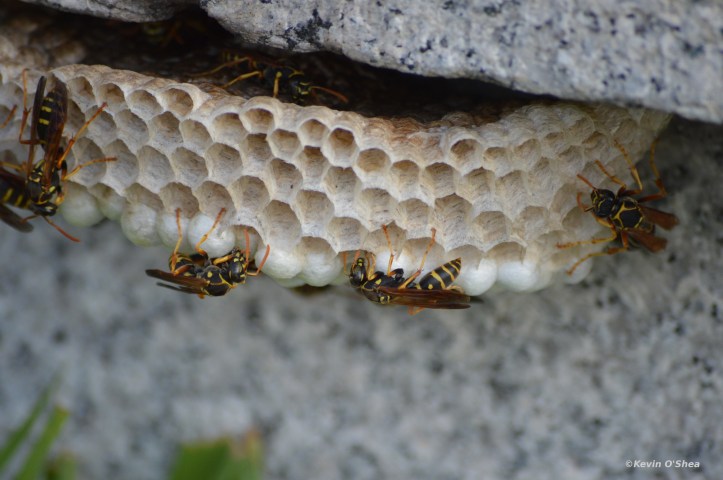


Early in the spring queens who were inseminated the previous fall, emerge from winter hibernation and build their initial nest. The first broods to emerge in late spring and early summer are entirely female. Males are produced in later/larger broods.
In the early days of the colony, it is far too dangerous for the queen to leave the nest unattended and forage so it is common for them to kill some of the larvae and feed them to over larvae. As the colony grows, the wasps leave the nest in search of food.

The most common food source for Paper Wasps are caterpillars. These soft-bodied insects don’t stand a chance against the mandibles and stingers of the wasps.
Earlier this spring, my elementary school class had an interesting lesson involving Paper Wasps. My class had planted a small garden at school. They were keeping an observation journal about the plants. We realized that moths had laid eggs all over our eight basil plants. Soon the eggs hatched and there were dozens of caterpillars eating the basil.
One day a student called to me and said there were hornets all over the basil plants. Upon further observation it was clear to see several very active hornets flying in and out of the basil plants killing the caterpillars!
This is one of the reasons that many people in Japan; especially people in the agricultural industry consider Paper Wasps to be useful insects. The Paper wasp is an “Eki-chu” 益虫 or beneficial insect.
This is a video I filmed and posted to YouTube several years ago of a paper Wap attacking and eating a caterpillar in Japan.
These creatures are fascinating to watch and definitely play a beneficial role in the natural world both in pollination and pest control.
They sometimes startle people while flying around the city foraging, but for the most part leave people alone if undisturbed. They are far less aggressive than the larger Giant Asian Hornets in Japan. The Giant Hornets or Osuzumaebachi are apex predators in the Japanese insect world and they actually prey upon Paper Wasps and their nests.

Remember, if you ever see a Paper Wasp flying about, it will more than likely leave you alone unless you do something to make it defensive.
It’s also a good idea to steer clear of their nests and if you find one, make sure children don’t play to close to it.
About the writer:
Kevin O’Shea is a Canadian PYP (elementary school) teacher at an international school in Kobe, Japan. He is a podcaster, birder and insect enthusiast.
Check out his Birds of Kansai Facebook page for lots of great nature photography and information from Japan.
Twitter: @madformaple
All photos were taken by Kevin O’Shea unless otherwise stated.
 Just Japan Stuff